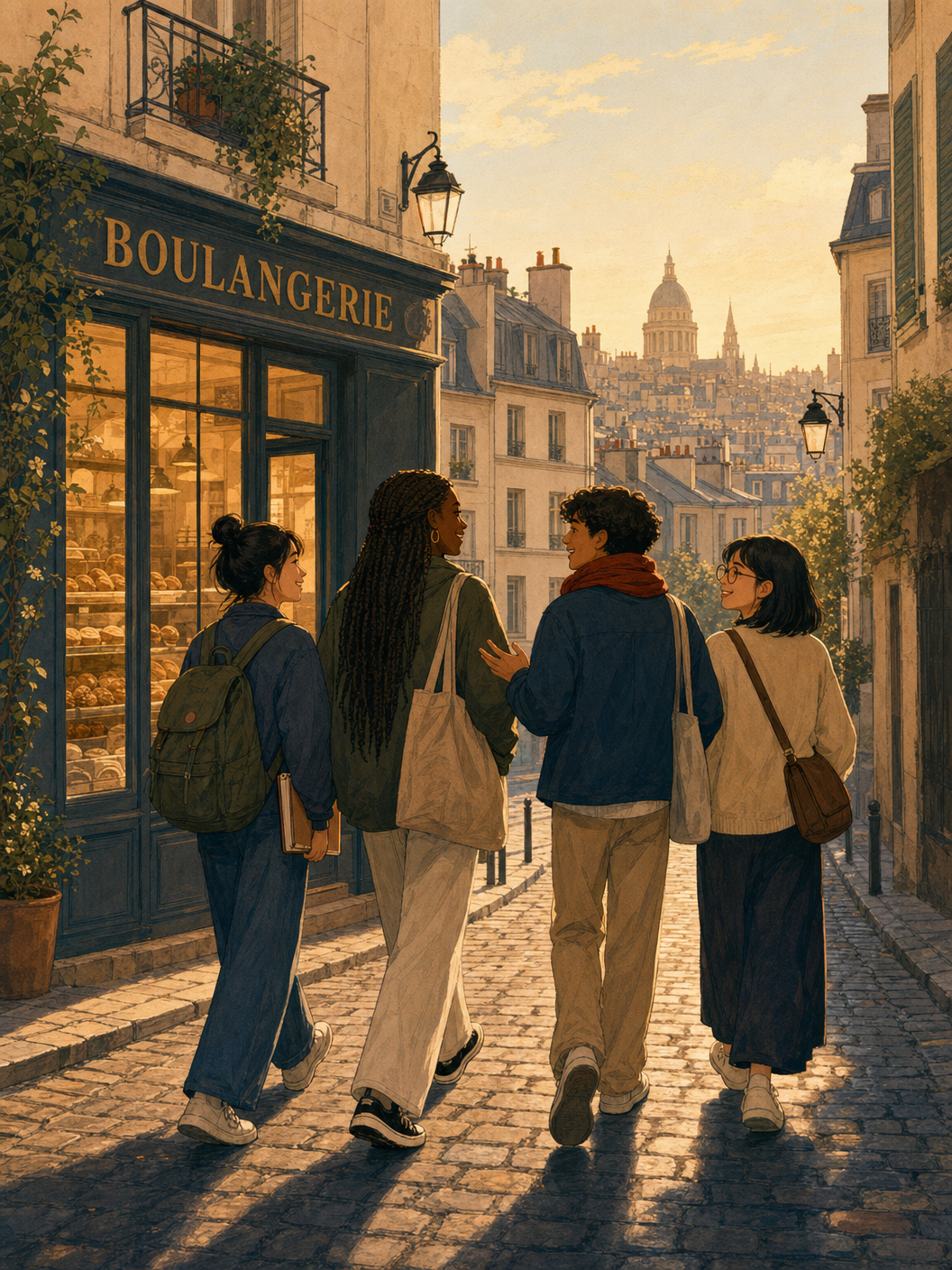
Dedicated to all past, present and future LAF1201 students
5 May 2026
Story Contents
Five episodes across fourteen class sessions. Each session has two parts (A & B) and matches one chapter in the story.
Avant de commencer
This is the story of four people who arrive in Paris on the same day, and discover, slowly, that they are going to spend two months becoming each other's family.
Each chapter corresponds to one of your class periods. The labels — 1A, 1B, 2A, 2B, and so on — match the structure of your course: each three-hour session is a pair of 90-minute periods, AM and PM, and each period has its own scene in the story.
You can read this however you want. Some students read each chapter the morning of the class. Some read the whole episode at once over the weekend. Some forget about the book for two weeks and then read six chapters in one sitting on a train.
The French in this book is the French you are learning. The early chapters use only the structures from Unité 0 and Unité 1; the later chapters draw on what you have learned by then. If you do not understand a French sentence the first time, that is fine — you will, by the end of the relevant week.
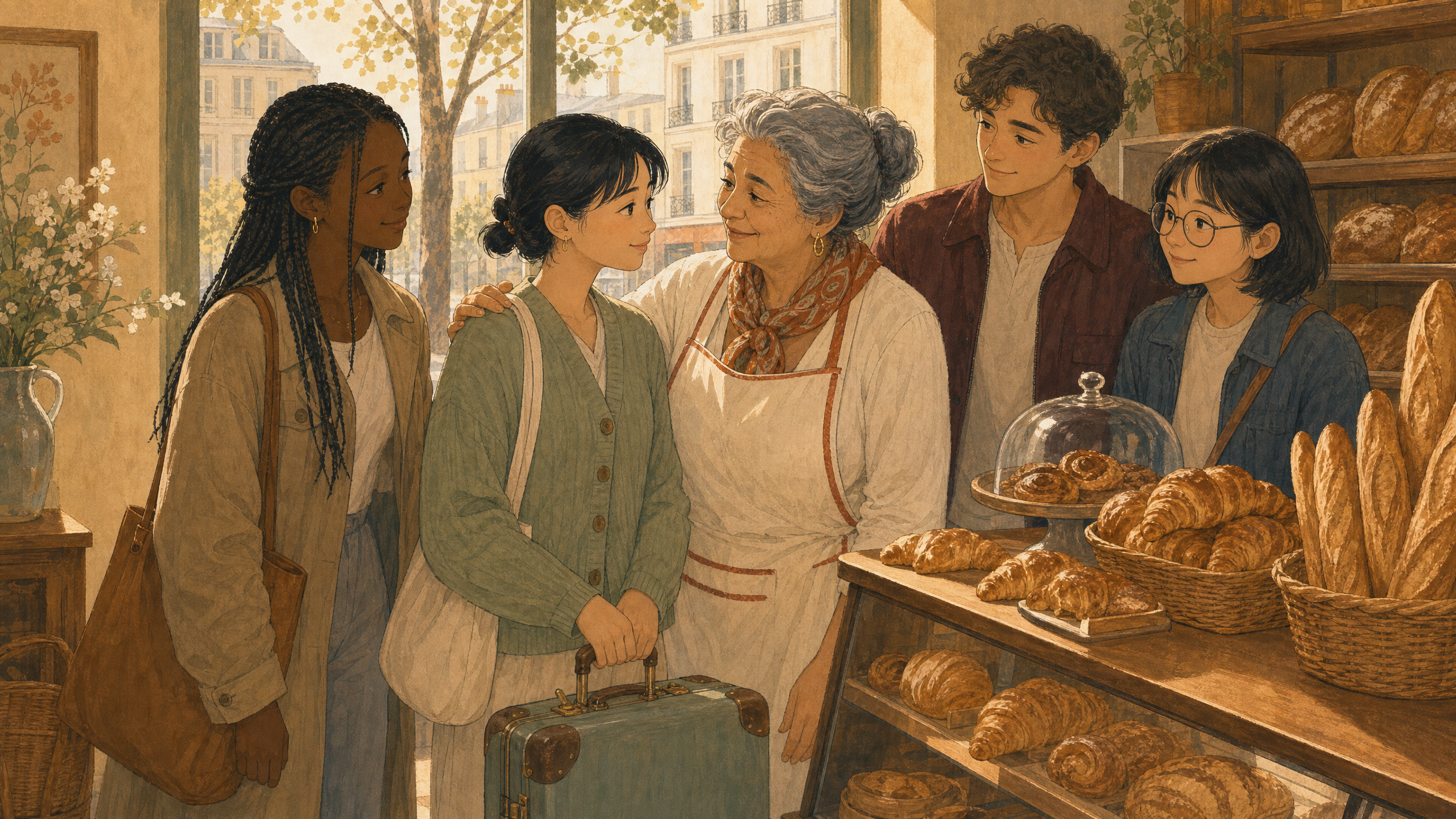
The four characters are Wei, Amara, Mateo, and Yuki. There is also Madame Benali, who runs the boulangerie on their street, and Madame Sow, who owns the bookshop where Amara works. They are older. They know Paris. They speak slowly to people who are learning.
Bonne lecture. (Happy reading.)
Les personnages
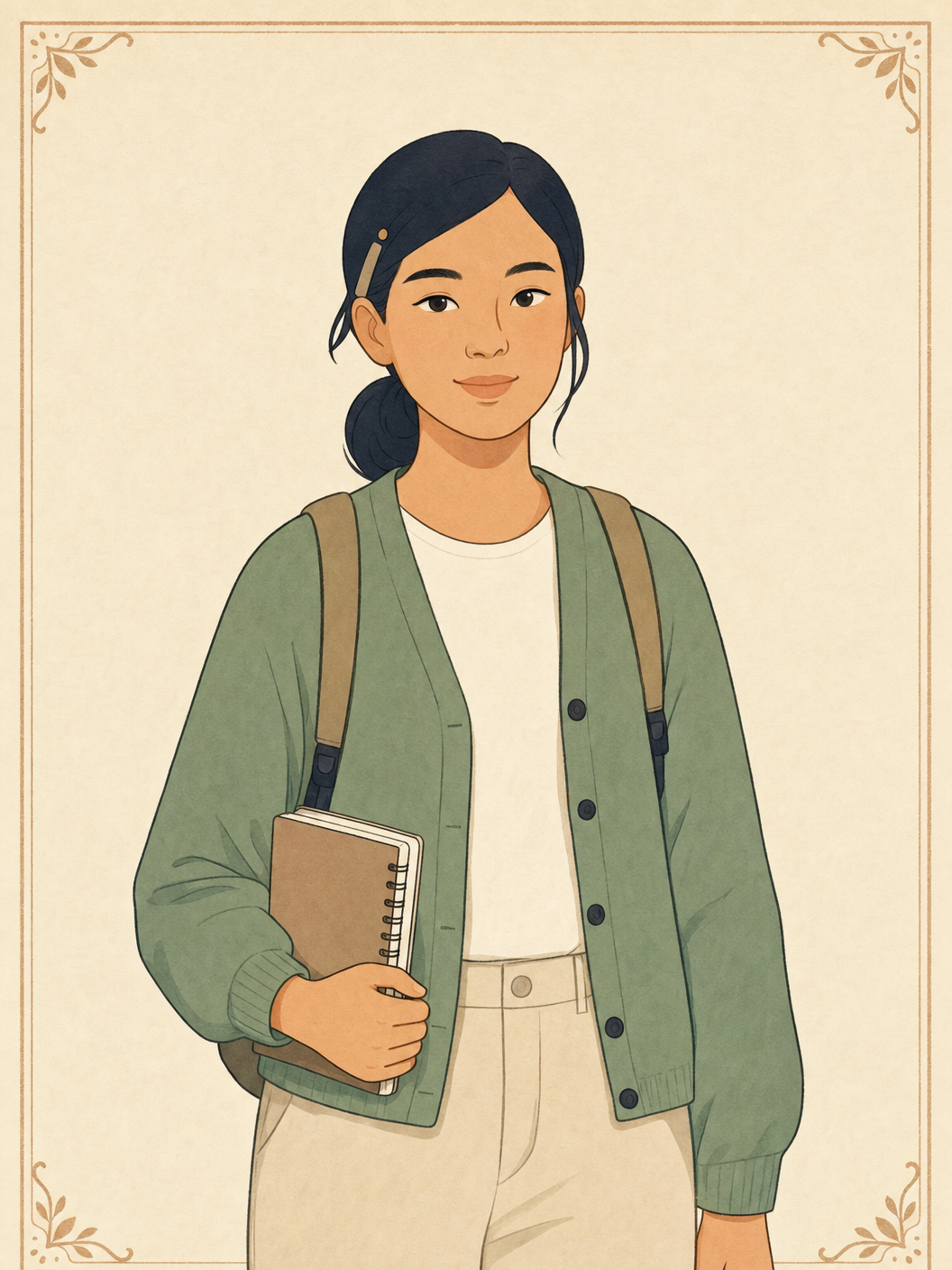
Wei Lin Chua · 魏琳
Reserved, observant, writes everything down. Speaks formal French but thinks in careful steps. Her default is listening before speaking.
"I prefer to ask questions quietly, to understand completely before I reply."
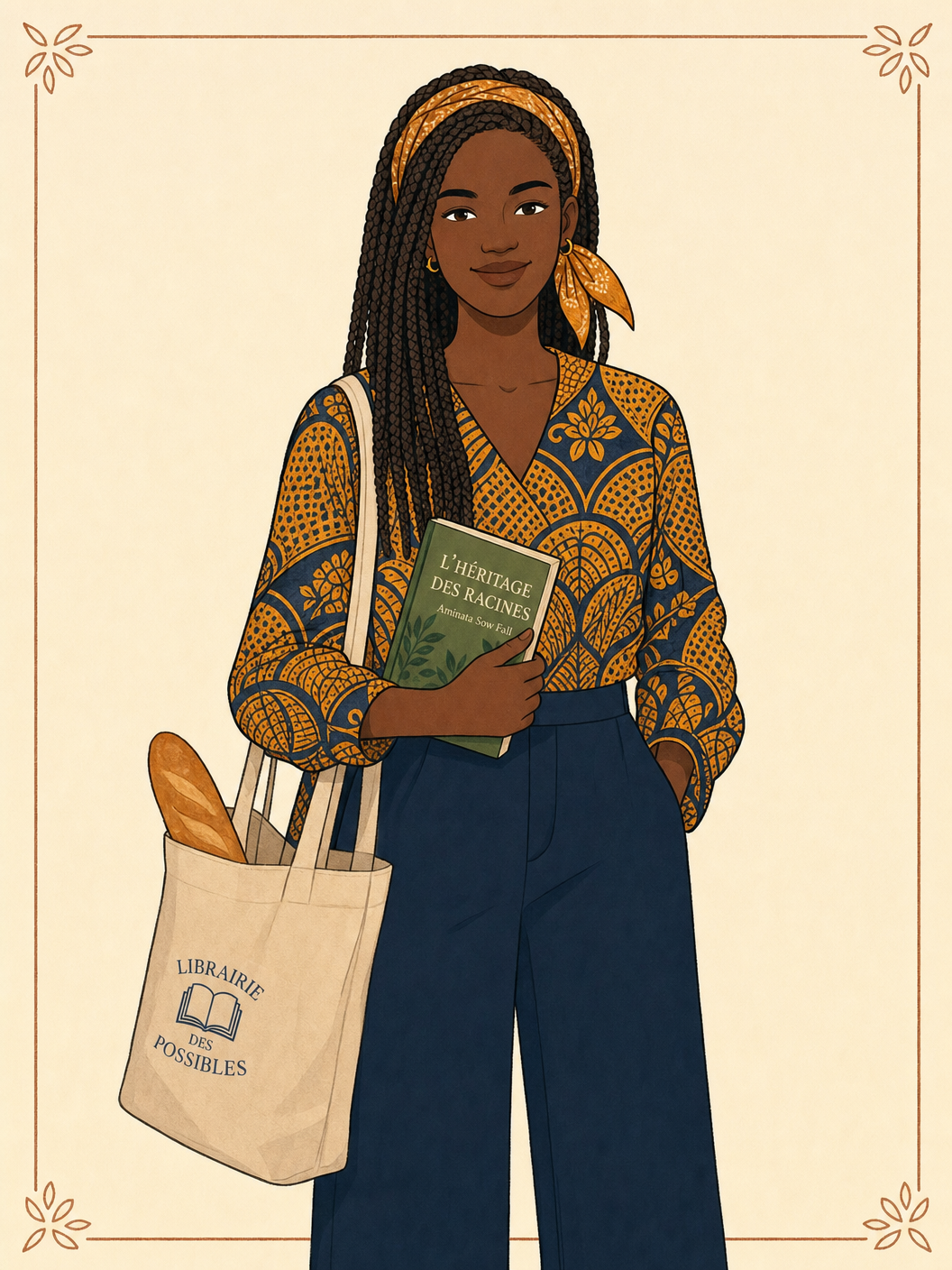
Amara Diallo
Warm, confident, with an easy smile. From the Casamance region; her family speaks Diola, Wolof, and French. She has worked two afternoons a week at La Fougère since March. French is her second language — she speaks it with the fluency of someone at home in the Francophone world.
"Books are how I invite people into my world. Language is the same — it's an invitation."
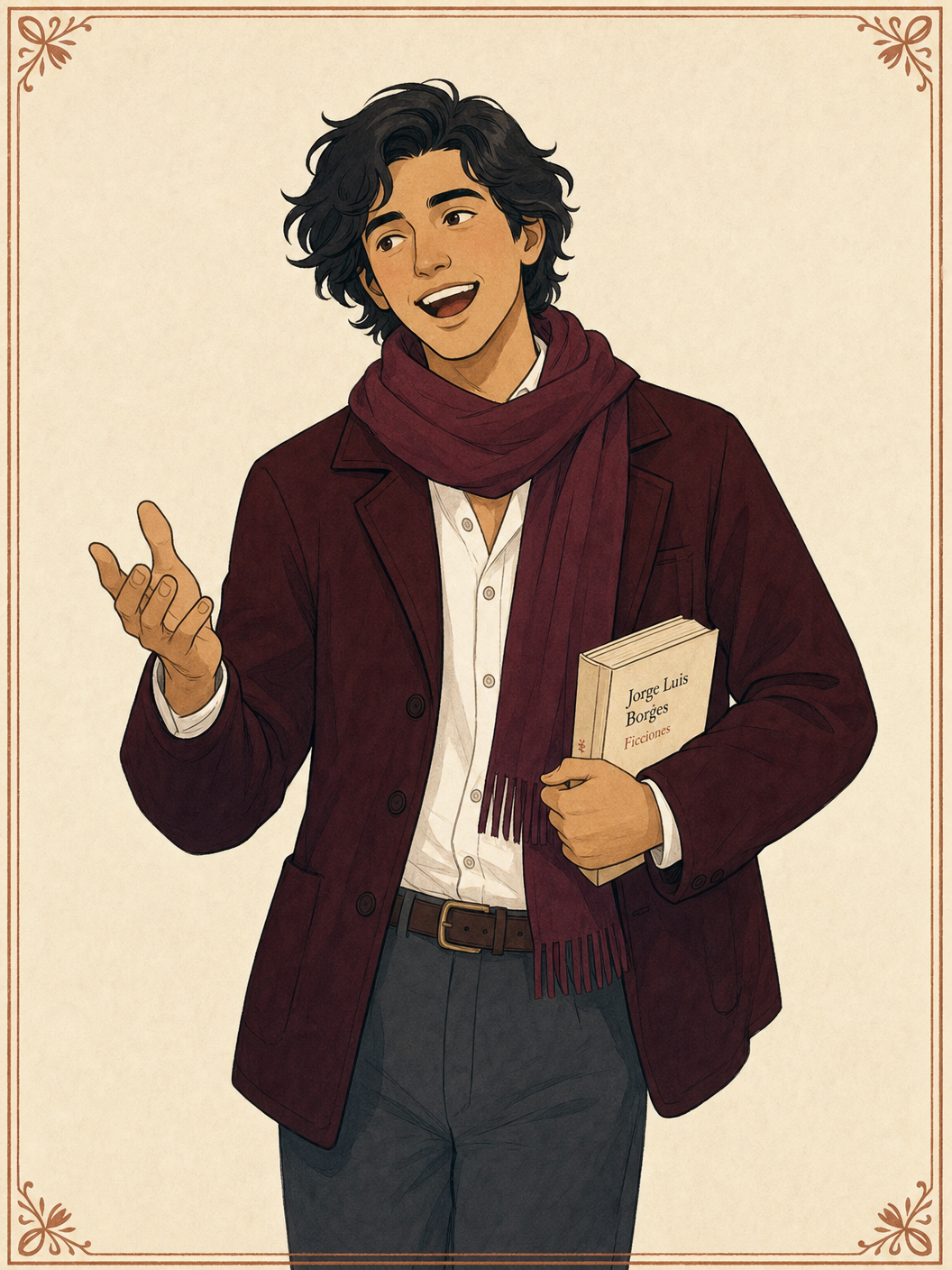
Mateo Reyes
Animated, theatrical, always mid-gesture or mid-word. His French is expressive but unpolished — he takes risks, speaks with his hands, sometimes makes mistakes and laughs.
"I say it wrong so I remember it right. The mistakes are part of learning — and the fun."

Yuki Tanaka
Poised, alert, always taking notes. Wears round glasses and carries a voice recorder and a small hardcover notebook. Her French is careful and correct.
"I observe first. I understand the shape of things before I write about them."
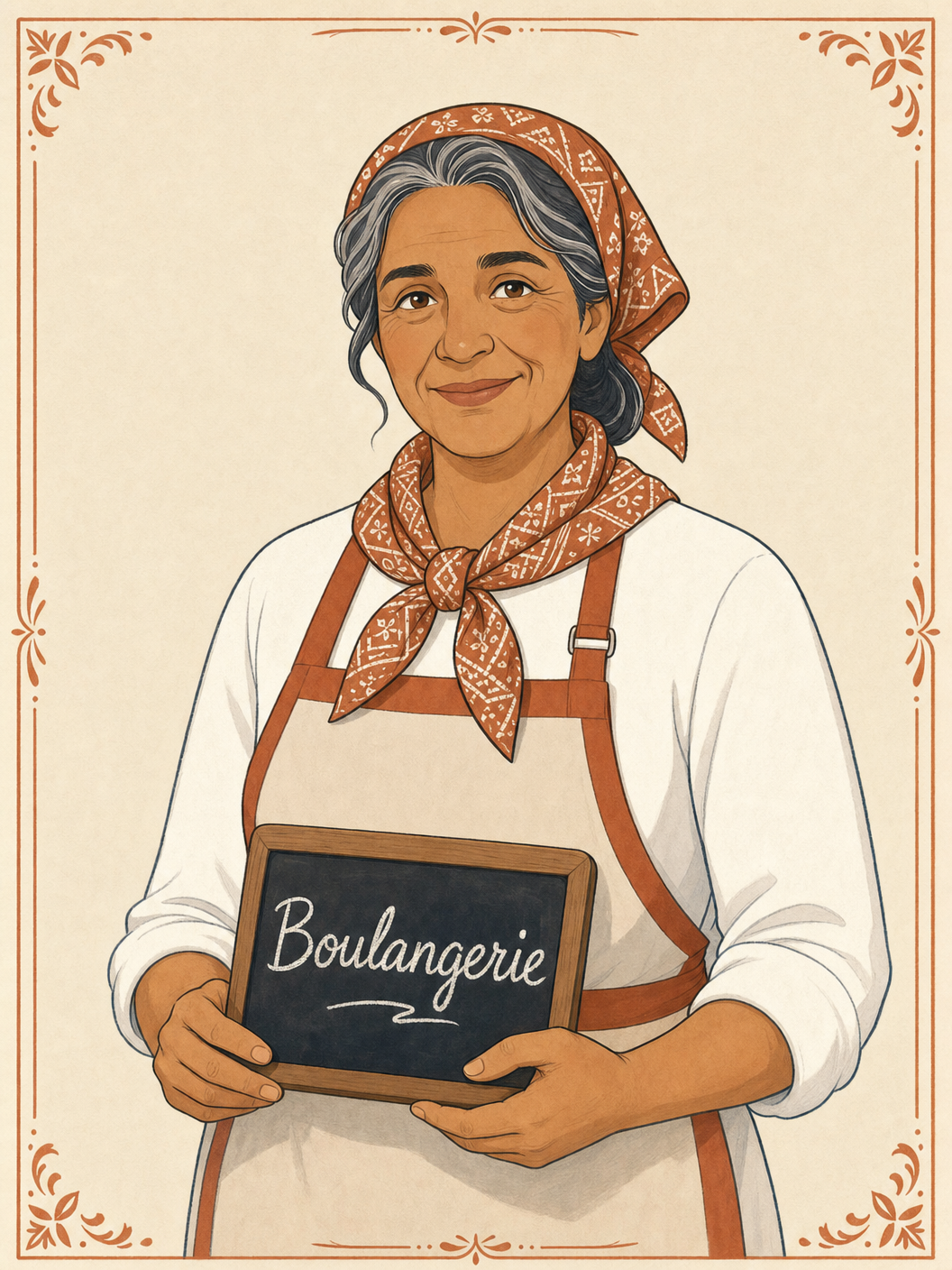
Madame Aïcha Benali
Owns and runs the boulangerie below their flat. Warm, present, with hands always busy. Deep kind eyes, crow's-feet, and a laugh that fills the shop. She remembers everyone's order.
"I have seen many students come and go. I know who they are by their bread."
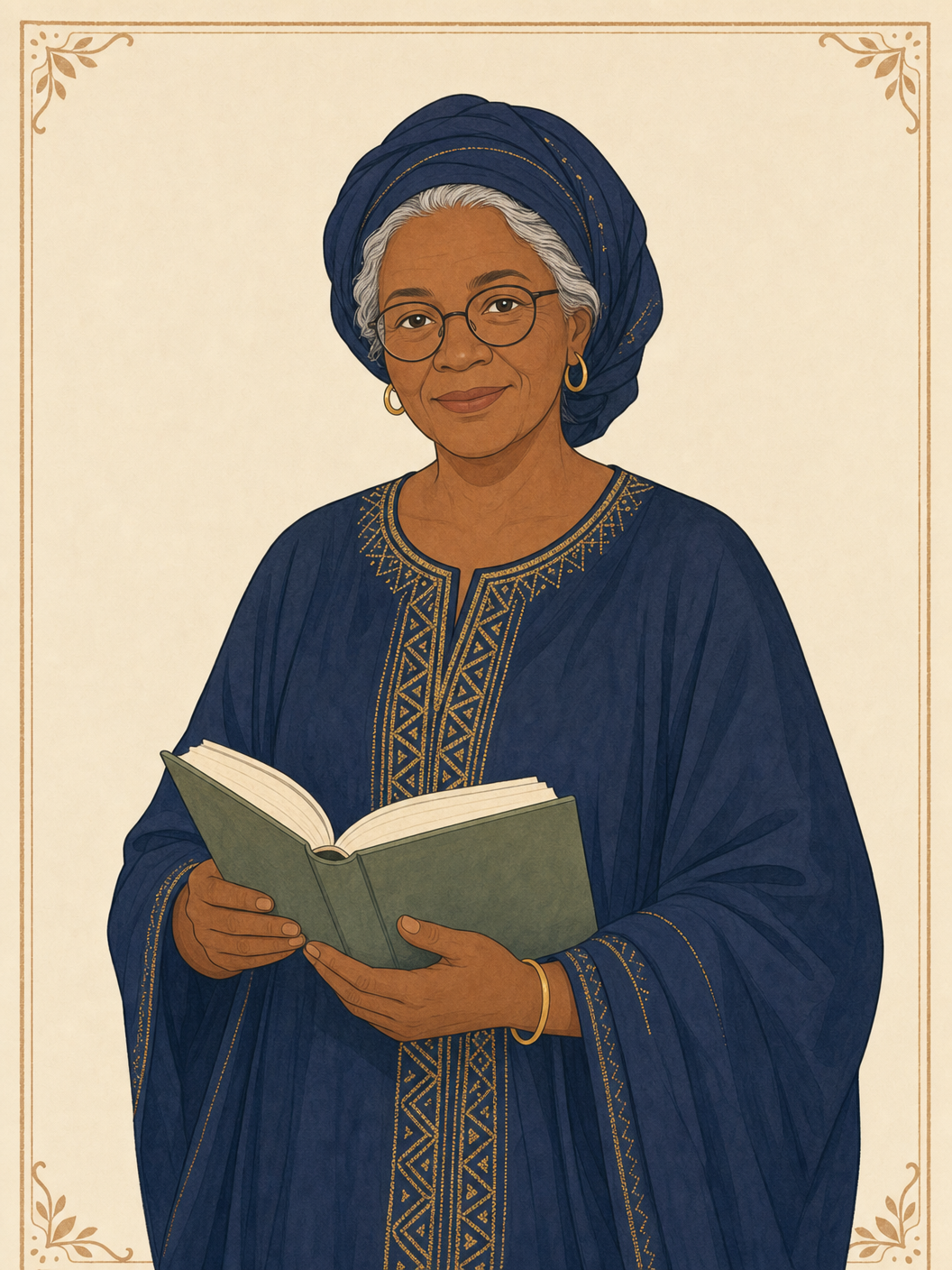
Madame Aïssatou Sow
Originally from Saint-Louis, she has lived in Paris since 1979. She runs La Fougère, a neighbourhood bookshop specialising in French literature alongside a smaller, fierce collection in Wolof, Pulaar, and Diola. She employs Amara two afternoons a week. She is a quiet mentor to the group — less visible than Madame Benali, but equally important.
"A bookshop is a place where every language is welcome. That is the point."
QUATRE À PARIS
deux mois, quatre voix
—
Le récit qui accompagne le cours LAF1201
A reader for students
Épisode 1
Sessions 1 → 3
Bonjour, Paris
Sessions 1–3 · Périodes 1A à 3B
1A · Lundi 11 mai, sept heures du matin
Wei has slept three hours. Or maybe four. The flight from Singapore was eleven hours, and then there was the airport, and then there was the metro, and then there was the small apartment on the rue des Cinq-Diamants where she fell onto a mattress at four in the morning without unpacking. Now it is seven, and the sun is hard and white through the window, and she is hungry.
She walks down five flights of stairs that smell of coffee and old wood. The street is narrow. Across the road, a woman is washing the windows of a small shop. Above the door it says BOULANGERIE in gold letters that have been there a long time.
Wei pushes the door. A bell rings.
The woman behind the counter has grey hair pulled into a bun, and she is arranging croissants in a basket. She looks up. Her face is kind. Wei has rehearsed this sentence on the plane. She tries it now.
— Bonjour Madame.
Her voice comes out smaller than she meant it to. The woman smiles. She does not seem in a hurry.
— Bonjour ma belle. Tu es nouvelle, toi ?
Wei does not know all the words, but she understands the question. She nods.
— Euh… oui. Je m'appelle Wei.
— Wei. C'est joli. Tu viens d'où ?
— Je suis singapourienne.
The woman's face lights up.
— Singapour ! Bienvenue à Paris, Wei. Qu'est-ce que tu prends ?
Wei points at a croissant. She does not know how to ask for it properly yet. The woman laughs gently — not at her, with her — and slides the croissant into a small paper bag.
— Un croissant. Ça fait un euro vingt.
Wei pays. She has rehearsed this part too.
— Merci, Madame.
— Bonne journée, Wei. À demain.
Wei steps out into the morning. The bell rings again behind her. She walks slowly back up the rue des Cinq-Diamants, eating the croissant with one hand. It is the best thing she has ever tasted. She does not yet know that three other people, in three different parts of the city, are also having a first morning. She does not yet know that two hours from now, all four of them will be sitting in the same classroom.
1B · Lundi 11 mai, neuf heures cinq
The classroom is on the third floor. Salle 304. Wei pushes open the door at five past nine and three faces lift to look at her.
The first is a young woman sitting at the front, completely still, with three pens lined up on her desk in order of length. She has a notebook open. She is already writing, even though nothing has happened yet. This is Yuki.
The second is a man at the back, talking very loudly on the phone in a language that is not French. He waves at Wei without breaking his sentence. He is wearing a scarf indoors. This is Mateo.
The third is a woman sitting in the middle row, working through a paperback in French — one finger on the page, lips moving slightly. She has long braids and a laugh that the others can already hear, even though she is alone. She nods at Wei without speaking. This is Amara.
Wei sits down two seats away from Amara. Nobody speaks. The clock ticks.
At nine ten, the instructor enters. She is small, sharp, and immediately at the front of the room. She places her bag on the desk and turns.
— Bonjour à tous.
Three voices reply: Bonjour Madame. Yuki and Wei say it carefully. Amara says it warmly.
Mateo, finishing his phone call at the back, looks up brightly and calls out:
— Salut !
There is a small silence. The instructor smiles. It is a patient smile. She walks down the aisle towards Mateo, slowly, and stops at his desk.
— Bonjour, monsieur. En classe, on dit « bonjour » et « vous ». D'accord ?
— Ah. Oui. Pardon, Madame. Bonjour, Madame.
A few minutes later, Mateo raised his hand again.
— Madame, quel temps fait-il aujourd'hui ?
The instructor gestured towards the window. Outside, the sky was pale blue and sharp.
— Il fait beau, mais il fait un peu froid ce matin. Et demain ?
— Demain, il pleut peut-être.
Mateo looked at Yuki. Yuki looked at her itinerary. She had already accounted for this.
Yuki, at the front, writes something in her notebook. Amara hides a smile behind her paperback. Wei looks down at her hands and tries not to laugh.
It is, all four of them later agree, the first lesson.
By the end of the morning, they have learned the alphabet, the days of the week, six colours, and five things the instructor will say to them every day for the next two months. They have not, however, said anything to each other.
At twelve thirty, the bell rings. Wei stands up. Yuki is already halfway out the door. Mateo is back on his phone. Amara is looking at Wei.
At some point during the morning, Mateo leaned across the aisle towards Wei and held out his hand, palm up. He had no pen. He had brought a notebook, a scarf, and a phone charger. He had not brought a pen.
— Tu as un stylo ?
Wei, who had two pens, a pencil, a highlighter, and a small ruler, looked at him. She passed him a pen without speaking.
— Merci. Et un cahier ?
Wei looked at him again. She tore three pages from her own notebook and passed them over.
— J'ai un livre, mais je n'ai pas de cahier.
He said this with the tone of a man explaining a reasonable life choice. Yuki, who had heard all of this, wrote something in her notebook. What she wrote was: Mateo — zéro stylo, zéro cahier. Beaucoup de confiance.
— Tu déjeunes où ?
Wei does not know how to answer. She smiles, helplessly. Amara nods, as if she had expected this.
— D'accord. À cet après-midi.
And she is gone.
2A · Mercredi 13 mai, neuf heures
Two days have passed. The four of them have been in the same room for two mornings and two afternoons, and they have still not really spoken to each other. They have only said: Bonjour. Au revoir. Pardon. Excusez-moi. The kind of words you say to strangers in lifts.
This morning, the instructor has decided that this will end.
— Aujourd'hui, on se présente. Vraiment. Un par un. Levez-vous, dites votre nom, votre nationalité, votre profession. Allez.
Yuki goes first. She has prepared notes. Of course she has. She stands up, smooths her skirt, and reads from a small card she has clearly written the night before.
— Je m'appelle Yuki Tanaka. Je suis japonaise. Je suis journaliste. J'ai vingt-quatre ans.
Then she sits down. The whole performance has taken eleven seconds.
Mateo goes second. He stands up. He has not prepared notes. He does not need notes.
— Bonjour ! Je m'appelle Mateo. Mateo Reyes. Je suis argentin — de Buenos Aires — et je suis ACTEUR.
He says the word ACTEUR with both hands raised. Yuki, in the front row, writes something in her notebook. Amara is laughing, openly now.
Then it is Amara's turn. She does not stand up. She turns in her seat to face the class, and she speaks with the calm of someone who knows exactly who she is.
— Je m'appelle Amara Diallo. Je suis sénégalaise, de Dakar. Je suis libraire. Et j'ai vingt-trois ans.
Mateo, behind her, claps. The instructor allows it.
Wei is last. Her heart is moving in a way she does not approve of. She stands up. The classroom seems very large. She opens her mouth.
— Je m'appelle Wei.
She sits down. Then she remembers. She stands up again.
— Pardon. Je m'appelle Wei Lin Chua. Je suis singapourienne. Je suis étudiante.
She sits down again, properly this time. The instructor nods.
— Très bien, Wei. Très bien.
And just like that — without anyone planning it — the four of them are no longer strangers.
The instructor was not finished.
— Maintenant, des questions. Posez des questions à votre voisin.
Mateo turned immediately to Amara.
— Quel âge as-tu, Amara ?
— J'ai vingt-trois ans. Et toi ?
— Vingt-deux ans. Quelle est ta profession ?
— Je suis libraire. Et toi, qu'est-ce que tu fais ?
— Je suis acteur.
He said it the same way he had said it the first time. Amara laughed the same way she had laughed the first time. Yuki, who had been listening, turned to Wei.
— Quelle est ta nationalité, Wei ?
— Je suis singapourienne. Et toi ?
— Japonaise. Quel est notre numéro de salle ?
Wei looked at the door. She had memorised it on the way in.
— Salle trois cent quatre.
Yuki nodded and wrote it down, even though she already knew.
2B · Mercredi 13 mai, après le déjeuner
After lunch, the conversation turns to where they are from.
Mateo, who has spent the entire lunch hour trying to make Amara laugh in three different languages and mostly succeeding, turns to her now and asks the question he has been wondering since Monday.
— Amara, on parle français au Sénégal ?
Amara smiles. It is not the first time she has been asked this. It will not be the last.
— Oui, Mateo. Et au Mali. Et en Côte d'Ivoire. Et au Cameroun. Et au Québec. Et en Belgique. Et en Suisse. La francophonie, c'est grand.
Wei, who has been quiet, asks the next question. It is a small question, but it matters to her.
— Amara, à Dakar, on parle français à la maison ?
Amara hesitates. She is, like the rest of them, an A1 student in this room — but unlike them, she has French in her ear from childhood. Her family is from the Casamance, the green forested region in the south of Senegal, far from Dakar. Her grandmother, who raised her, speaks Diola first, Wolof second, French third. The French Amara speaks is a French built on top of two other languages, in a region where the colonial overlay arrived later and stuck less. She has lived in Dakar for school. But the home that comes back to her in dreams is not the city.
She does not say all of this. What she says, in her A1 French, is short.
— À la maison, on parle diola. Et wolof. Et français. Trois langues.
Yuki, in the front row, is taking notes. Of course she is. She looks up.
— Combien de pays ?
— Vingt-neuf, je crois. Plus ou moins.
The instructor pulls up a map on the screen. The map is half-pink: France, Belgium, Switzerland, Canada, much of West Africa, parts of North Africa, parts of Southeast Asia, a few islands in the Pacific. Wei has not realised it was this big. She has thought of French as a language that belongs to Paris.
Now she looks at the map and thinks: oh.
That evening, Yuki sits at her small desk in her small apartment, two streets from the boulangerie, and writes in her notebook in Japanese. She writes: Today I learned that the Francophone world is much larger than France. I am writing my article in the wrong direction. I should start with the world, and then come back to Paris.
Then she closes her notebook. It is nine in the evening. She does not yet know that tomorrow morning, when she opens her registration packet from the school, she will discover something that is wrong.
3A · Vendredi 15 mai, neuf heures
Yuki notices the error at eight forty-five in the morning. She is sitting on the edge of her bed, going through her welcome packet with a highlighter, when she sees the line that says NATIONALITÉ and reads, in small dark letters, what someone has typed there.
Chinoise.
Yuki is not Chinese. Yuki is Japanese. She knows this, her passport knows this, her parents know this, and the Tokyo online publication that is paying for her six-month assignment in Paris definitely knows this. But the school does not know this. Or rather, the school used to know this — she filled in the form herself in February — but somewhere between February and May, someone has retyped the form, and that person has made a mistake.
Yuki does not know, yet, that this small error is going to be the reason the four of them finally start being friends.
She walks into the classroom at nine. She is, for once, not on time — she is two minutes late, because she stopped to read the form three times to make sure she was not the one who was wrong. The other three look up.
— Yuki, ça va ?
It is Amara who asks. Yuki sits down. She holds up the form.
— Il y a un problème.
She explains. Mateo, who has been waiting for something dramatic to happen all week, listens with his entire body. Wei looks concerned. Amara nods slowly.
— Tu dois aller au secrétariat.
— Oui. Mais je suis nerveuse.
Mateo, who is a poor judge of timing but a good judge of feeling, leans forward.
— Tu as peur ?
— Un peu. J'ai chaud. J'ai soif aussi.
— Quelle est la salle ? On t'accompagne.
— Salle vingt-trois. Au deuxième étage.
— On vient avec toi.
It is decided in three seconds. At the eleven o'clock break, all four of them walk together down the corridor to the secretariat — Yuki holding her form, Amara walking on her left, Wei walking on her right, and Mateo a few steps behind, narrating the situation to nobody in particular.
— C'est un drame. C'est un vrai drame administratif. Yuki, tu es très courageuse.
— Mateo, tais-toi.
— D'accord.
They reach the door of the secretariat. Yuki takes a breath. She knocks. Inside, a woman looks up from her computer.
It is the first time the four of them have done anything together. Yuki, holding her form, walks in alone — but she walks in knowing that three people are waiting for her in the corridor.
3B · Vendredi 15 mai, l'après-midi
The secretariat trip went well. Of course it did. The form was reprinted; Yuki signed it; the woman behind the desk smiled and said — slowly, kindly, the way Madame Benali says things — that these mistakes happen, that Yuki was right to come, that her French was very clear. Yuki walked back into the corridor with the new form in her hand and three people waiting for her, and she did not cry, but she came close.
Now it is two in the afternoon. The four of them are sitting in the small courtyard of the school, on a stone bench, in the May sun. The instructor has given them a task: invent a Francophone identity. Make up a person. Give them a name, a nationality, a profession, an age. Present them to the class.
Mateo, naturally, has gone first.
— Il s'appelle Pablo Cinéma.
— Mateo, ce n'est pas un nom.
— Si. Maintenant oui. Pablo Cinéma. Il est québécois. Il est réalisateur. Il a quarante ans. Il a deux chats.
— Mateo, on n'a pas appris « chats » encore.
— Justement.
Amara goes next. She has invented a woman called Awa, a doctor from Dakar who works in Marseille. The story is small and complete. Wei thinks Amara's invented woman is more real than her own actual self.
Yuki has invented a Belgian journalist with a cat. (Mateo applauds the cat.) When it is Wei's turn, she opens her mouth, and what comes out surprises her.
— Elle s'appelle Marie. Elle est française. Elle est photographe. Elle a vingt-cinq ans. Elle aime Paris.
It is, in fact, the kind of person Wei thought she would become if she ever moved to Paris. The other three nod approvingly. None of them know — Wei does not even know herself, fully — that she has just described a small bolder version of who she would like to be.
At the end of the afternoon, walking out of the school, the four of them discover something that none of them had realised.
They have been comparing addresses. Wei lives at number twelve, rue des Cinq-Diamants, third floor. Yuki lives at number twelve, rue des Cinq-Diamants, second floor. Mateo lives at number twelve, rue des Cinq-Diamants, fourth floor. Amara lives at number twelve, rue des Cinq-Diamants, first floor — directly above Madame Benali's boulangerie.
They have been living in the same building for a week. They have passed each other on the stairs, in the courtyard, at the front door. None of them have recognised each other.
Mateo is the first to laugh. Then Amara. Then Wei. Yuki stands very still for a moment, processing the data, and then begins to laugh too.
Amara puts her hand on Wei's shoulder.
— Bon. Alors lundi matin, on se voit à la boulangerie. Sept heures et demie. D'accord ?
— D'accord.
Episode 1 ends here, on the rue des Cinq-Diamants, on a Friday afternoon in May, with four people who realised they have been neighbours all along.
Fin de l’Épisode 1
Épisode 2
Sessions 4 → 7
Sessions 4–7 · Périodes 4A à 7B
4A · Lundi 18 mai, huit heures
On Monday morning at seven thirty, four people walk into Madame Benali's boulangerie at the same time.
Madame Benali looks up. She looks at Wei, then at Amara, then at Yuki, then at Mateo. Her eyes get wider. Her smile gets bigger.
— Mais… mais vous vous connaissez, vous quatre ?
— Nous sommes dans la même classe à l'école, Madame.
— Vous habitez tous chez moi !
She comes out from behind the counter, which she does not usually do, and she looks at them with her hands on her hips.
— Vous habitez tous au numéro douze. Au-dessus de ma boulangerie. Et vous ne le saviez pas ?
— On vient de le découvrir, Madame. Vendredi soir.
Madame Benali shakes her head. She is laughing now.
— Mais alors vous êtes une famille. Une famille au-dessus de ma boulangerie. Bienvenue à la maison, vous quatre.
She gives them four croissants. She refuses to take payment. She says it is for the première fois — the first time they have come in together. Mateo tries to argue. Amara, who knows when an older woman has decided something, stops him with a look.
They eat the croissants standing on the pavement, in the May sun, and Madame Benali, watching them through the window of her shop, asks the question that will define the rest of the week.
— Alors, qu'est-ce que vous faites ce week-end, vous quatre ?
Nobody has an answer.
4B · Lundi 18 mai, quatorze heures
In the afternoon, in class, the four of them sit at the same table for the first time. The instructor has set them a task: introduce yourselves to each other properly. What do you like? What don't you like? What do you do on a Saturday?
It sounds simple. It is not simple.
— Moi, j'adore les livres. J'aime aller à la librairie. J'aime danser. Je n'aime pas le métro à six heures du soir.
— J'adore le cinéma. J'adore la musique. J'adore le théâtre. Je n'aime pas les emails administratifs.
— Mateo, personne n'aime les emails administratifs.
— Justement.
— J'aime les bibliothèques. J'aime les expositions. J'aime le bon café. J'aime les listes. Je déteste être en retard.
— Yuki, « j'aime les listes »… c'est très Yuki.
— Merci, Mateo.
— J'aime la photographie. J'aime marcher. J'aime le silence. Je n'aime pas les fêtes très bruyantes. Et… j'aime le thé. Pas le café.
Mateo gasps theatrically.
— Wei. Tu n'aimes pas le café ?
— Non.
— Tu es à Paris.
— Je sais.
They all laugh. The instructor, watching from the front, lets them. After a moment she taps the board.
— Bon. Maintenant. Vous allez au cinéma le samedi ? Au marché ? À la bibliothèque ? Vous travaillez le dimanche ?
They go around the table again. Amara goes to the market on Saturday mornings. Mateo goes to the cinema on Saturday afternoons. Yuki goes to the bibliothèque on Sunday mornings. Wei has not, in fact, decided yet what she does in Paris on a weekend.
At four in the afternoon, walking out of the school, Amara turns to the others.
— Bon. Samedi. On fait quoi ?
Nobody answers immediately. Mateo, behind them, is humming.
— On parle de samedi mercredi. D'accord ?
— Mercredi ? Mais c'est e-learning mercredi.
— Justement. On a le temps.
Amara says it brightly, but Wei has the small feeling that Amara has just deferred a decision none of them is ready to make.
5A · Mardi soir, l'erreur
This part of the story did not happen in a classroom. It happened on a Tuesday evening, in Mateo's apartment on the fourth floor of number twelve, rue des Cinq-Diamants, while he sat at the small kitchen table with his laptop and a glass of wine and decided that he, personally, would solve the weekend problem.
He had a plan. He had had it since Monday evening. The plan was: send everyone an email tonight with a precise programme. By Wednesday morning, when they all logged in for the e-learning session, the question would already be answered.
Mateo wrote the email. It was, Mateo thought, perhaps the best email anyone had ever written. It was four sentences long. It said:
Bonjour mes amis. Voici mon programme pour samedi : marché à dix heures, cinéma à dix-neuf heures. Mon idée : on va au marché, et après on va au cinéma. Qu'est-ce que vous en pensez ?
He proofread it. He smiled at it. He typed the email addresses into the To field — A for Amara, W for Wei, Y for Yuki — and then, without thinking, typed M for Mateo, because he wanted to copy himself, except his contact list helpfully suggested Mathieu Lamy, who is a man Mateo met once at a bar in February and whose phone number he should have deleted.
Mateo, distracted by his own email, accepted the suggestion.
Mateo sent the email.
At eleven thirty-seven that night, Mateo received a reply. He read it. He blinked. He read it again. The reply said:
Bonjour Mateo, je crois que ce message n'est pas pour moi ? Je ne connais pas Amara, ni Wei, ni Yuki. Mais le programme du week-end a l'air très sympa. Bon courage, Mathieu Lamy.
Mateo put his head in his hands.
Then he opened the group WhatsApp — the one the four of them had created on Friday — and typed: J'ai un petit problème.
5B · Mercredi, les fiches et le projet
The Wednesday e-learning session is, in theory, asynchronous. The four of them are supposed to do their tasks individually, on their own time, before Friday.
Instead, by ten in the morning, they are all sitting at Amara's kitchen table. Amara has made coffee for everyone except Wei (who has tea). Yuki has brought her laptop and a printout of the Canvas instructions. Mateo, who is still mortified about Mathieu Lamy, has brought biscuits as a peace offering.
The first task is the email atelier. Yuki reads the brief aloud.
— Demander un programme par courriel. Cinquante à quatre-vingts mots. Politesse, structure, salutations.
They look at Mateo.
— C'est moi qui écris.
— Mateo, non.
— Si. Je dois apprendre.
So Mateo writes. He writes slowly. Yuki corrects his commas. Amara reads each sentence aloud, and they decide together whether it sounds like a person or a robot. Wei reads the final version and says, simply, that it is much better than yesterday's version. Mateo accepts this with rare humility.
They draft, together, a polite reply to Mathieu Lamy. Yuki types it. It is fifty-eight words long. It says, in French that any of them would have been proud of: I am very sorry. My friend made a mistake. We are four students learning French in Paris. We do not know you. We hope you have a good weekend. Thank you for your kindness.
Yuki sends it. Mathieu Lamy replies within the hour. He says her email is charming. He says she should not apologise. He says he wishes them all bon week-end.
The second task is the Projet culturel: a fiche d'identité — an identity card — for one Francophone film. They each have to choose one and present it.
Mateo has, of course, been waiting for this his entire life.
— Atlantique. Mati Diop. Sénégal et France, deux mille dix-neuf. Une histoire de fantômes, de mer, et de migration.
He says it like he is announcing a Cannes prize. The others let him. Amara, after a moment, suggests they all go to see something by Mati Diop together — there is, she has heard, a small retrospective at a cinema in the eleventh arrondissement this Saturday afternoon.
— Samedi ? Mais on n'a pas de programme pour samedi.
— Maintenant on en a un.
It is decided in eleven seconds. Mateo's original plan — the marché in the morning, the cinéma later — survives. Amara adds a stop at the canal Saint-Martin in the afternoon, for Wei. Yuki writes down a precise schedule. Wei checks the weather (it will not rain). Mateo is told, gently but firmly, not to send any further emails this week.
On Saturday, the plan works. All of it. The marché in the morning. The canal in the afternoon. The Mati Diop film in the evening — a film about water and ghosts and Dakar, which Wei does not understand all of in French but feels deeply anyway.
Walking back along the rue des Cinq-Diamants at eleven that night, with the smell of Madame Benali's bakery already starting up for Sunday morning, Wei thought: I have spent a Saturday in Paris with three friends. The thought was so new and so strange that she said it out loud, in English, to nobody.
Mateo, who had heard her, said, in his own loud French:
— Wei parle ! Wei fait un commentaire spontané !
— Mateo. Tais-toi.
— D'accord.
6A · Lundi 25 mai, la semaine de révision commence
The second e-learning week. No physical class. The exam is on Friday.
On Monday morning, the four of them met in the small shared salon on the ground floor of number twelve — a room with two old armchairs, a table that wobbled, and a bookshelf full of books that nobody had read in twenty years. The Canvas tasks for the week did not require this. They could have done them alone, at home, on their laptops. They chose not to.
Yuki had brought flashcards. Forty-six flashcards. She had made them at midnight.
Amara had brought a tray of small almond cakes. She had baked them at six in the morning. She did not say this; Wei could tell from her hands, which still had a small dusting of flour.
Mateo had brought, unaccountably, a bottle of red wine. Yuki confiscated it.
— Mateo, c'est lundi matin.
— Pour la fin de la semaine.
— On va voir.
Wei had brought nothing, because Wei had not slept well, because Wei had spent the weekend in a low panic about Friday's exam. Amara, taking one look at her, gave her an almond cake.
— Mange. On va commencer.
They started with greetings. Then numbers. Then être. Then avoir. Then s'appeler. Yuki produced flashcards at appropriate intervals. Mateo answered everything in a confident voice and sometimes in the wrong tense. Yuki, who had been keeping a list of his most stubborn errors, gently corrected him. Wei, slowly, began to feel less like she was going to be sick.
By the afternoon they had moved on to Unité 2: articles, possessives, the goûts vocabulary, telling the time. By six in the evening they had stopped, ordered Vietnamese food from the place on the corner, and gone home.
They would meet again on Wednesday. They would meet again on Thursday. By Thursday night, Wei would not be afraid.
Or — that was what she told herself.
6B · Jeudi soir, vingt-trois heures
Three days later. Thursday night. The exam is in nine hours.
Wei cannot sleep. She gets out of bed at quarter past eleven and sits at her tiny kitchen table with a notebook, and she writes down everything she has learned in two weeks. She writes the French alphabet. She writes the numbers from zero to sixty-nine. She writes je suis, tu es, il est, elle est, nous sommes, vous êtes, ils sont, elles sont. She writes them again. She writes je m'appelle, je suis singapourienne, j'ai vingt et un ans.
She writes for an hour. The list gets longer. The list also, somehow, makes her feel calmer.
At twelve thirty, she hears footsteps on the stairs. The footsteps go down — not up. She listens. There is the sound of someone moving around in the kitchen on the floor below.
Wei wraps a cardigan around her shoulders and goes downstairs.
Amara is in the small kitchen on the second floor, which is technically Yuki's kitchen but which Amara seems to have unofficially adopted. She is putting something into the oven. She is wearing a t-shirt and jeans and she does not look like a person who has been asleep.
— Wei. Tu ne dors pas ?
— Non. Toi non plus ?
— Je fais des gâteaux pour demain. Pour après l'examen. Pour la chance.
Wei sits down at the small kitchen table. The clock on the wall says twelve thirty-three.
Amara sits down opposite her.
— Wei, écoute-moi. Demain, ça va aller. Tu sais beaucoup. Tu sais plus que tu penses.
— Tu crois ?
— Je sais.
They sit together for forty minutes, drinking tea — Amara has made tea — and quietly going through tu/vous distinctions in French, and laughing once or twice, and Wei goes back upstairs at one fifteen and falls asleep in seven minutes.
The next morning, on the way to the exam, Madame Benali gives each of them a croissant.
— Pour la chance, mes enfants.
Amara smiles. Mateo says it is going to be a triumph. Yuki adjusts her pen. Wei does not say anything. But she is not afraid.
7A · Vendredi 29 mai, le matin
The exam happens. There is not very much to say about it, because exams happen the same way everywhere: silence, paper, a clock that moves slowly, and then suddenly very fast at the end.
In the morning, there is the listening section. Wei listens to four short conversations and answers questions. The voices on the recording are clear; they speak slightly slower than real life, which is a kindness; she gets most of the answers and is fairly sure about the others.
Then there is the reading section. A short text about a young woman in Lyon. A form to complete. A postcard from a friend in Brussels. Wei reads each one twice, the way Amara told her to. She answers calmly. She does not panic when there is a word she does not know — Amara has told her, also, that you do not need every word to understand a sentence.
At eleven thirty, the listening and reading section ends. There is a fifteen-minute break.
Wei steps out into the corridor. Mateo, in the corridor, is silent. Mateo is never silent. Yuki is silent too, but Yuki is often silent. Amara is the first to speak.
— Comment ça va ?
— Ça va. Je crois.
— Mateo ?
— Triomphe.
— Triomphe ?
— Triomphe. Probablement.
Amara laughs. They drink water from a fountain in the corridor. They do not look at their phones. They do not talk about the exam. They simply stand together in a small silent group, four people who have been quietly preparing each other for this morning for two weeks.
At eleven forty-five, the second half begins.
7B · Vendredi 29 mai, l'après-midi
The writing section is forty minutes. Wei writes a short email — to a fictional cousin who is coming to Paris next month — describing what they should bring, what the weather is like, and what they will do together. She uses the structures she practised on Thursday night. Je suis, j'ai, je vais. The email is, by the end, eighty-three words long. She rereads it. She is satisfied.
The speaking section is the part she has been afraid of. She is called in last, alphabetically. Mateo goes first (and exits the small examination room with his thumbs up). Yuki goes second (silent, focused). Amara goes third (already laughing, before the door closes).
Then it is Wei's turn. She walks into the small room. There is the instructor, who smiles at her. There is a second teacher she has never seen before, who is the assessor.
— Bonjour, Wei. Asseyez-vous. Vous êtes prête ?
— Oui, Madame.
The instructor asks her three questions. What is your name. Where are you from. What do you like to do on the weekend. Wei answers each one carefully. The instructor nods. The second teacher writes something on a piece of paper.
Then the second teacher asks her one more question — not from the script, just a real question.
— Et vous habitez où, à Paris ?
Wei smiles. This one she knows.
— J'habite au-dessus d'une boulangerie. Au numéro douze, rue des Cinq-Diamants. Je vis avec trois amis. On est arrivés tous les quatre le même jour. C'est… c'est une coïncidence. Mais c'est aussi une famille.
The second teacher looks up from her paper. She is no longer writing. She is smiling.
— C'est une belle réponse, Wei. Merci.
Wei walks out of the room. The other three are waiting for her in the corridor. Amara looks at her face.
— Ça s'est bien passé.
— Oui.
Episode 2 ends here, in a corridor at twelve minutes past two on a Friday afternoon, with four people who do not yet know their results but who are no longer afraid of the next part.
Fin de l’Épisode 2
Épisode 3 — Je suis perdue
Sessions 8 → 9
Sessions 8–9 · Périodes 8A à 9B
8A · Mercredi 3 juin, après la pluie
It rained all night Tuesday. Hard rain, the kind that wakes you up. By Wednesday morning the streets were clean and the air was sharp and the sun had come back as if nothing had happened.
The four of them met at the boulangerie at seven thirty, the way they had every weekday for the past fortnight. They had not seen each other since Friday. Madame Benali was the first to speak.
— Alors, l'examen ?
— Triomphe.
— Mateo, tu n'as pas encore les résultats.
— C'est pour ça. Triomphe possible.
Amara said it had been correct. Yuki said it had been correct. Wei did not say anything but looked happy. Madame Benali, who knew when not to push, gave them their croissants and waved them out.
In the classroom, the instructor spent the first ten minutes giving general feedback on the exam. Common errors. Things to remember. Then she clapped her hands once.
— Bon. On continue. Aujourd'hui, on parle de la météo.
Yuki, who had filled six pages of her notebook with weather vocabulary the previous evening, was ready. Mateo, who had not, raised his hand.
— Madame, comment on dit « il fait beau » en grec ?
— Mateo, ce n'est pas un cours de grec.
— Pardon, Madame.
A few minutes later, Mateo raised his hand again.
— Madame, quel temps fait-il aujourd'hui ?
The instructor gestured towards the window. Outside, the sky was pale blue and sharp.
— Il fait beau, mais il fait un peu froid ce matin. Et demain ?
— Demain, il pleut peut-être.
Mateo looked at Yuki. Yuki looked at her itinerary. She had already accounted for this.
They learned: il fait beau, il fait chaud, il fait froid, il pleut, il neige, il y a du vent. They learned the ordinal numbers — premier, deuxième, troisième — because the city was about to become important. They learned that Madame Benali's boulangerie was in the thirteenth arrondissement, which Mateo immediately announced to the class as if it were a personal achievement.
By the end of the morning, the four of them had drawn a rough map of Paris on a piece of paper, with the boulangerie marked at the centre, and the school marked half an hour away by metro, and small notes for places they wanted to visit. Yuki had labelled it carefully. Wei had drawn small arrows. Amara had added the marché. Mateo had added six cinemas.
It was not yet a plan. But it was the beginning of one.
8B · Mercredi 3 juin, l'après-midi
In the afternoon, Yuki announced that she had drawn up a full day's itinerary. For Friday.
Yuki's itinerary was fifteen pages long.
Amara stared at it.
— Yuki, on va à un marché. Pas à la guerre.
— C'est pareil. Il faut un plan.
— Quinze pages ?
— Quatorze. La dernière page, c'est en cas de pluie.
The itinerary was, in fact, beautiful. It contained: the marché aux puces in the eighteenth arrondissement at ten, lunch in the eleventh at one, a museum in the seventh at two thirty, and the canal Saint-Martin at five. Each segment had a metro line, a precise time, and a backup option.
Mateo read it slowly.
— Yuki, tu es trop organisée.
— Et toi, pas assez.
— C'est vrai. C'est pour ça qu'on est amis.
They spent the rest of the afternoon learning how to ask for information about a city. Est-ce qu'il y a un métro à proximité. Qu'est-ce qu'il y a à voir dans le dix-huitième. Comment on va de Place d'Aligre à la Cinémathèque. Yuki asked every possible question. Mateo answered most of them creatively. The instructor patiently rerouted him to the actual question. Wei wrote everything down.
At the end of the afternoon, walking home along the rue des Cinq-Diamants, Amara turned to Yuki.
— Tu sais que le plan ne va pas tenir, non ?
— Le plan va tenir.
— Avec Mateo dans le groupe ?
Yuki paused. She looked at Mateo, who was a few steps ahead, talking enthusiastically to nobody.
— Le plan va presque tenir.
— Voilà.
9A · Vendredi 5 juin, le débriefing
The plan held for three hours.
They started at ten at the marché aux puces, exactly as Yuki had specified. Amara was in her element — bargaining with a vendor over the price of a small antique mirror, even though they were not buying the mirror, simply for the pleasure of it. Wei photographed everything. Yuki took notes. Mateo, briefly, was a model citizen.
They had lunch at twelve thirty in the eleventh, in a small place Yuki had researched. They were laughing. The plan was holding.
At one fifty-five, they were walking past the rue Mouffetard, on their way back to the metro to go to the museum, when Mateo heard the brass band.
It was not a large brass band. It was four people — a trumpet, a tuba, two clarinets — playing something cheerful on the corner of a small square. Mateo stopped walking. The other three did not notice, immediately, because they were ahead of him.
By the time they noticed, Mateo was thirty metres behind them, dancing — actually dancing — to the brass band, with two French children who had also stopped to watch.
— Mateo !
— Une minute !
It was not a minute. It was twenty minutes. By the time they had retrieved Mateo, they had missed the metro window for the museum, and the schedule was beginning to slip. Yuki, in a calm voice that was much more concerning than a loud voice would have been, suggested they recalibrate.
They did not recalibrate. They split up. Amara wanted to walk to the canal directly. Mateo wanted to find another brass band. Wei said she would go ahead to the metro and meet them there. Yuki, alone of the four, said this was a bad idea.
Wei went to the metro. Wei went to the wrong metro. Wei realised she was at the wrong metro half an hour later, when she got off at a station called Stalingrad and recognised nothing.
She was alone. Her phone had two percent battery. The signs were in French, of course they were, and she had practised reading them, but reading a sign in a textbook is different from reading a sign when you are lost.
She breathed. She looked around. There was an older man waiting at a bus stop. He had a kind face. He was reading a newspaper.
Wei walked over. She rehearsed the sentence twice in her head. Then she said it.
— Excusez-moi, monsieur. Je suis perdue.
The man lowered his newspaper. He looked at her. He did not look in a hurry.
— Pas de problème. Vous allez où ?
— Au treizième. Rue des Cinq-Diamants. J'ai besoin du métro.
— D'accord. Vous prenez la ligne sept. Direction Mairie d'Ivry. Vous descendez à Place d'Italie. C'est facile.
— Et le métro, c'est où ?
— Tout droit. Cinquante mètres. À droite, vous voyez l'entrée. Je vous fais un petit plan ?
— Je voudrais bien. Merci, monsieur.
And Wei, slowly, sentence by careful sentence, asked her way home — and the man, slowly, sentence by careful sentence, told her. He told her twice. He drew a small map on the back of his newspaper. He told her she was very brave to ask in French. He told her she was already nearly there.
Wei got back to the rue des Cinq-Diamants at six fifteen that evening. Amara was sitting on the front step of the building. When Amara saw her, she stood up, and she did not say anything, and she gave Wei a hug.
— On était inquiets.
— Je sais. Pardon.
— Non. Tu as fait quelque chose de courageux.
Madame Benali, who had been watching from her shop, came out and put her hand briefly on Wei's shoulder. She did not say anything. She did not need to.
9B · Vendredi 5 juin, dans l'arrière-boutique
On Friday afternoon, after class, something unusual happened.
Madame Benali — who had been watching the four of them carefully all week, in the way that a woman who has run a boulangerie for thirty-five years watches everything — came out from behind her counter and turned the small sign on the door from OUVERT to FERMÉ.
— Venez. Tous les quatre. Dans l'arrière-boutique.
They followed her. The arrière-boutique — the back room of the shop — was small and warm. There was a wooden table, four chairs, and a kettle. Madame Benali made them tea. She did not say anything for a few minutes, just moved around the room with the small confident movements of a person who knew exactly where everything was.
Then she sat down.
— Bon. La semaine prochaine, ma cousine arrive de Marseille. Elle va passer trois jours à Paris. Elle ne connaît pas la ville. Elle a besoin d'un programme. Vous allez m'aider ?
They looked at each other.
— Un programme pour votre cousine ?
— Oui. Un vrai programme. Avec des arrondissements, des stations de métro, des choses à voir. Vous, vous savez maintenant comment marche cette ville.
Mateo, who five minutes earlier had been complaining about being tired, sat up straight. This was, after all, his territory. He had been waiting for this his entire life.
— Madame, on va faire le meilleur programme de Paris.
— Mateo, calme-toi.
They sat in the back room for two hours. They drew up an itinerary that did not collapse. They argued about whether the cousine should start in the eighteenth or the eleventh. They learned the words for prendre le métro, descendre à la station, traverser la rue, tourner à droite. They learned the pronoun y, which meant there, and which Mateo immediately overused (j'y vais, on y va, tu y vas, il y va) until Yuki begged him to stop.
By six in the evening, the program existed. Three days. Six arrondissements. Four metro lines. A small list of places that were not in the guidebooks. Yuki had typed it. Wei had drawn small arrows on a printed map. Amara had added one sentence at the bottom in her own handwriting: "Madame Benali says: ask the boulangère on rue des Cinq-Diamants for directions if you are lost."
Madame Benali read the document. She read it twice. She did not speak for a moment. Then she folded it carefully in two, and she put it in the pocket of her apron, and she looked at them.
— Vous voyez ? Vous savez parler français. Vous savez Paris. C'est une ville qui est à vous, maintenant.
Episode 3 ends here, in the back room of a boulangerie in the thirteenth arrondissement, on a Friday in June, with four people who can read a map of a city they did not know two months ago, and a woman who can no longer count them as strangers.
Fin de l’Épisode 3
Épisode 4
Sessions 10 → 11
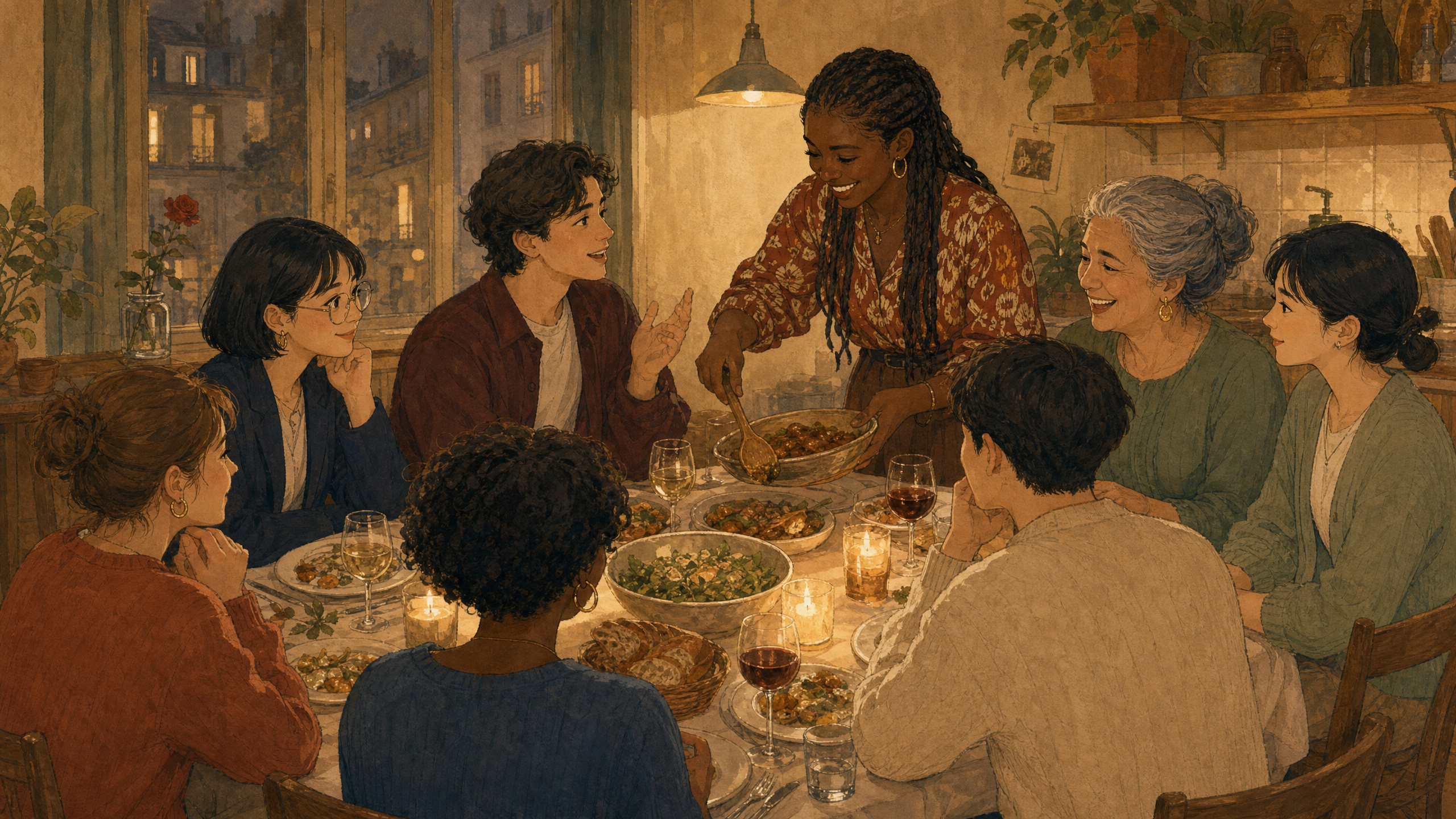
Le grand dîner
Sessions 10–11 · Périodes 10A à 11B
10A · Lundi 8 juin, neuf heures
Le lundi matin à la boulangerie, Amara les attendait quand ils sont descendus pour leurs croissants. She was not eating. She was not in line. She was standing by the window with her arms crossed, smiling like someone who had decided something over the weekend.
— J'ai une idée.
— Bonjour à toi aussi, Amara.
— Pardon. Bonjour. J'ai une idée.
Madame Benali, behind the counter, looked up. The other three sat down at the small table by the window, the one Madame Benali had recently allowed them to use as if it had always been theirs.
— On fait un dîner.
— Quel dîner ?
— Un vrai dîner. Jeudi soir. Chez nous. Pour Madame Benali, pour le quartier, pour nous. On cuisine ensemble. On invite tout le monde.
Madame Benali heard. Madame Benali said nothing for a moment. Then she slowly put down the bread she was slicing, came around the counter, and sat down at the table with them. This was, all four of them noted, the first time in two months that Madame Benali had sat down with them in her own shop.
— Vous allez cuisiner pour moi, vous quatre ?
— Pour vous, Madame. Et pour le quartier. Tous les quatre, ensemble.
Madame Benali smiled. She did not say yes. She did not need to.
In class that morning, the instructor — without knowing — opened Unité 4.
— Aujourd'hui, on parle de ce qu'on mange et de ce qu'on boit. De fruits, de légumes. De combien de fois par semaine. Souvent. Parfois. Rarement. Jamais.
The four of them looked at each other. The timing was, even for Mateo, almost too convenient.
They learned the words. Manger. Boire. Du pain, de l'eau, du fromage, de la viande, des légumes. Frequency adverbs — toujours, souvent, parfois, rarement, jamais — which Wei found beautifully precise.
They went around the classroom, each person describing their habits.
— Je mange du riz tous les jours.
— Je bois beaucoup de café.
— Je ne mange jamais de viande le matin.
— Je mange parfois trois croissants au petit-déjeuner.
— Mateo, tu es ridicule.
— Justement.
By the end of the morning, the four of them had a vocabulary they did not have at breakfast. They also had a project. The two things, Wei thought, were not unrelated.
10B · Lundi 8 juin, le marché
The marché de la Place d'Aligre is a real place, and on a Monday afternoon in June, the four of them descended on it with a list.
Amara went to the fishmonger first. She negotiated. She had been negotiating with fishmongers since she was seven; this was, for her, recreational. The fishmonger, a man with thick eyebrows, raised his price. Amara raised hers. They argued cheerfully for five minutes, in French that Wei could understand maybe forty percent of, and then they shook hands and Amara walked away with a kilo and a half of poisson at a price that Yuki, watching the transaction, recorded with reverence.
Yuki tracked every centime. She had a small calculator. She also had a small pencil, and she had brought a small clipboard.
— Yuki, c'est un marché. Pas un audit.
— C'est les deux.
Wei read every label carefully, because Wei had discovered, over the past two weeks, that French food labels were a small efficient way of practising vocabulary. At the vegetable stall, she had her list. She had also, the night before, looked up the sentences she would need.
— Bonjour Madame. Je voudrais un kilo de tomates, s'il vous plaît.
The woman behind the stall nodded and began filling a paper bag.
— Et avec ça ?
— Un demi-kilo d'oignons, et quatre citrons.
— Vous avez de l'ail ?
— Oui. Six gousses ?
— Oui, s'il vous plaît. C'est combien ?
— Ça fait quatre euros vingt.
Wei counted out the coins exactly. She also bought a bunch of fresh coriander that the woman called persil arabe, which was not on the list but which smelled, Wei thought, like home.
Mateo got distracted by an accordionist.
This was inevitable. The accordionist was playing something melancholic at the corner of the square. Mateo stood for ten minutes, listening, and then put five euros in the man's hat. When he came back to the others, he was slightly tearful.
— C'était magnifique.
— Mateo, tu as les fromages ?
— Les fromages !
He had not bought the cheeses. He went back. He returned, twenty minutes later, with three cheeses (un comté, un brie, un chèvre), a small bottle of olive oil he had not been asked to buy, and a story about the woman at the fromagerie that they did not have time to listen to.
He told them anyway, walking home, his arms full of bags. The fromagerie woman had asked him what he was cooking. He had said:
— Un grand dîner. On a besoin de fromage. Beaucoup de fromage.
— Combien de personnes ?
— Neuf, dix peut-être. Madame, qu'est-ce que vous me conseillez ?
— Trois fromages. Un dur, un mou, un de chèvre. Trois cents grammes chacun. Et un peu d'huile d'olive, parce que vous allez en avoir besoin.
Yuki, listening to this story, made a small sound which was the closest thing to a laugh she had produced all day. The olive oil, it turned out, was the fromagerie woman's authority, not Mateo's improvisation.
By six in the evening, the four of them were back at number twelve, rue des Cinq-Diamants, with eight bags of food, sixty-two euros and forty cents of receipts (Yuki had checked), and a kitchen that needed to be cleaned before tomorrow.
They cleaned it. They cleaned it together. By eight, they had stopped speaking French and were singing along to something Mateo had put on his speaker.
None of them yet knew that on Wednesday, Mateo would forget something important.
11A · Mercredi 10 juin, neuf heures
A note about Madame Sow, who has been quietly present in the background of this story without anyone yet stopping to introduce her. Madame Aïssatou Sow is sixty-eight years old. She is from Saint-Louis, in the north of Senegal, and she has lived in Paris since 1979. For the last thirty years she has run a small librairie called La Fougère on the rue de Tolbiac, two streets from the boulangerie. The shop sells novels in French and a smaller, fiercer collection in Wolof, Pulaar, and Diola — books that are difficult to find anywhere else in Paris. Amara has been working there two afternoons a week since March: shelving stock, helping customers, learning the names of writers she had not been taught at school in Dakar. Madame Sow does not say much. When she does say something, the four of them have learned to listen.
On Wednesday morning, Mateo confessed. It happened at the librairie, in front of Madame Sow, which made it worse.
— Il n'y a pas de réservation.
— Il n'y a pas de réservation pour quoi ?
— Le restaurant. Pour ce soir.
Amara had wanted, before the big dinner on Thursday, to take Madame Sow out for a small thank-you meal. A pre-dinner. A small private acknowledgement, from the four of them to her, for three months of patience while Amara stumbled through inventories and shelving and customer questions in a French that had grown, by inches, into something Madame Sow could now actually rely on. The reservation had been Mateo's only job.
Amara stared at him. Yuki sighed — a long, controlled, deeply organised sigh. Wei, surprisingly, laughed. It was the first time she had laughed openly in front of all four of them, properly, with her whole face.
— Wei, tu trouves ça drôle ?
— Désolée. C'est juste… très Mateo.
Mateo nodded. He could not argue.
— On va trouver une solution.
— Comment ?
— On va improviser !
— Mateo, on est à Paris. À sept heures du soir. Sans réservation. C'est presque impossible.
— On va surtout réfléchir.
This was Wei. She had said it very quickly. Amara turned to look at her. Wei looked surprised at herself.
— D'accord. On va réfléchir.
In class that morning, the instructor — who did not know what they were planning — happened to teach the futur proche. Aller plus the infinitive. The grammar of what is going to happen next. Je vais aller. Tu vas manger. Nous allons trouver. They drilled it for an hour. By eleven, the four of them were planning the evening entirely in the futur proche.
— On va aller au restaurant. On va expliquer. On va demander gentiment. On va trouver une table.
— Et si non ?
— On va improviser.
— Yuki, on dit qu'on n'improvise pas.
— On dit qu'on n'improvise pas comme Mateo.
— C'est la même chose.
They argued, gently, until lunch.
11B · Mercredi 10 juin, la répétition
In the afternoon, in class, the instructor announced — having absolutely no idea — that they would be doing a role-play. The scene: a group of four arrives at a restaurant without a reservation. They must convince the server to give them a table. The dialogue must use the vocabulary of the unit.
The four of them looked at each other. Amara was the first to start laughing. Wei followed. Mateo, who was still slightly mortified, took a moment, and then he too started laughing.
They volunteered to go first.
It was, the instructor said afterwards, the most committed performance she had seen in fifteen years of teaching. Amara played herself. Mateo played himself. Wei played herself. Yuki played herself. The fifth student, a young man called Jean-Pierre who had been quiet all term, played the server, and he played him with the world-weary contempt of a man who had been waiting for this his entire life.
— Bonsoir. Vous avez une réservation ?
— Euh… normalement, oui.
— Mateo. Tu n'as pas réservé ?
— … J'ai oublié.
— Pardon, monsieur. On est quatre. Vous avez une table libre, par hasard ?
Jean-Pierre — the server — considered them for a long moment. Then he sighed, in the manner of a man who had seen everything, and gestured towards an imaginary table.
— Très bien. Voici la carte.
— Merci. Je voudrais le menu, s'il vous plaît.
— Comme entrée, je prends la soupe.
— Et comme plat ?
— Je prends le plat du jour. Et de l'eau, s'il vous plaît.
The class, watching, was very quiet. This was, everyone understood, no longer entirely a role-play.
At the end, Amara turned to Jean-Pierre with great dignity.
— L'addition, s'il vous plaît.
Jean-Pierre produced an imaginary bill. Amara paid with an imaginary card. She left an imaginary tip.
The role-play ran for fifteen minutes. The class applauded. Even Yuki, briefly, smiled.
That evening, the actual restaurant scene played out almost exactly the same way. The server was, against all probability, kind. He had a table by the window. He gave them his recommendation for the wine. Madame Sow — who had been told about the reservation problem only when they arrived — looked at Mateo for a long moment, then said, very dryly, that this was, on the whole, exactly the kind of thing she had expected from a young man who studied acting. Mateo's mortification finally dissolved into laughter, and the table relaxed.
They ate. They talked. Madame Sow told them, slowly and without sentimentality, about her arrival in Paris in 1979, when she was twenty-one, from Saint-Louis. She told them about the small bookshop on the rue de Tolbiac she had worked in for ten years before its owner died and left it to her. She told them what she had stocked first (Mariama Bâ, Sembène Ousmane, une seule étagère de poésie en wolof), and what she had stocked last (Léonora Miano, NoViolet Bulawayo, une section jeunesse en trois langues). She did not say it directly, but the four of them understood that the librairie was the project of her life.
They walked home along the rue des Cinq-Diamants under a clear June sky. Thursday — the big dinner — was twenty-four hours away.
Episode 4 ends here, on a Wednesday evening in June, with five people walking slowly home, full of food and wine, and a kitchen that, the next evening, would be the site of one of the small important nights of their lives.
Fin de l’Épisode 4
Épisode 5
Sessions 12 → 14
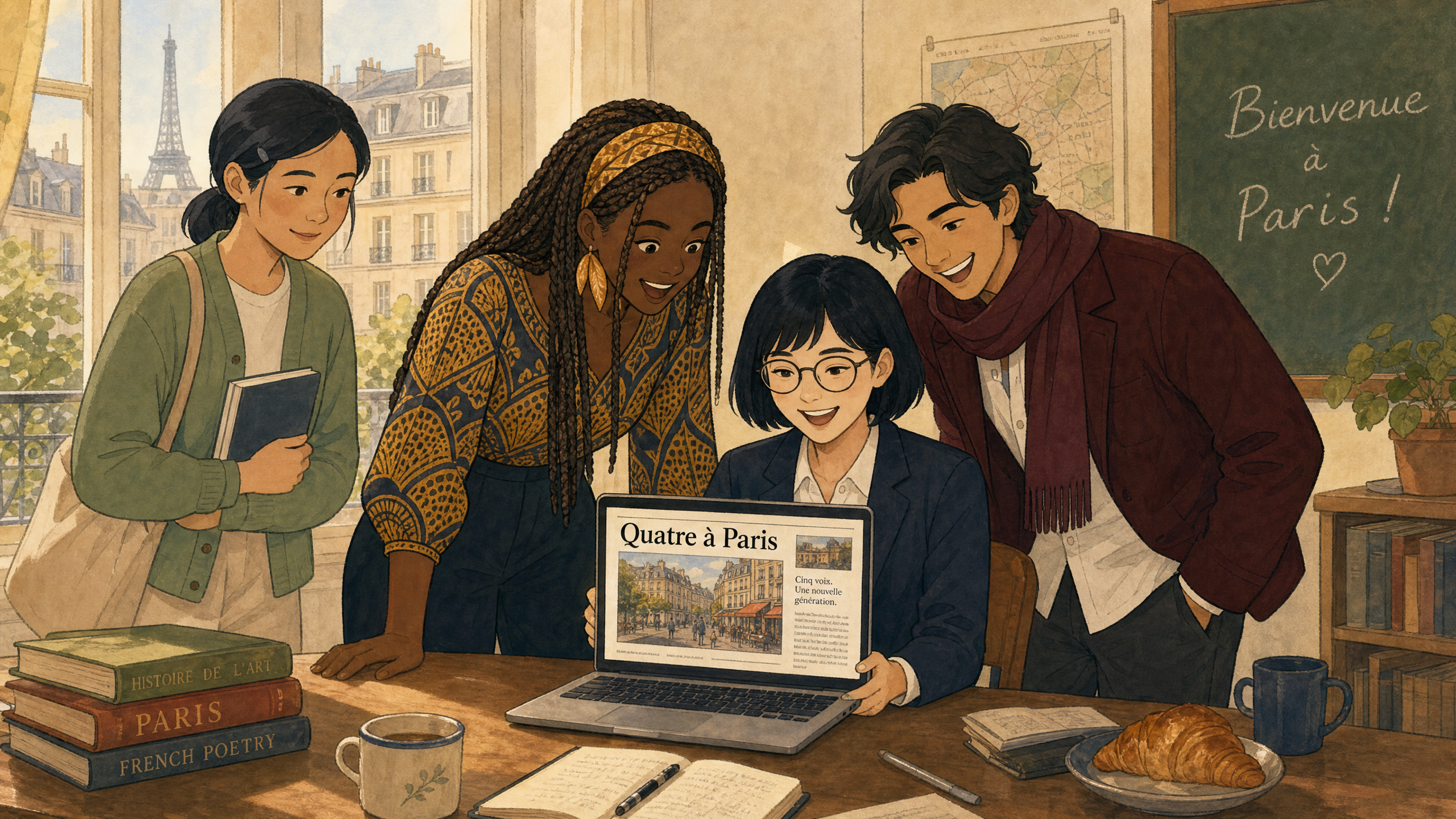
Bilan
Sessions 12–14 · Périodes 12A à 14B
12A · Vendredi 12 juin, le lendemain
The dinner happened on Thursday evening. Nine people in the small kitchen on the second floor — which Amara had transformed, with a tablecloth and small candles and a borrowed chair from the elderly couple upstairs, into a proper dining room. Madame Benali wore a green dress. Madame Benali's son, the postman, brought wine. The schoolteacher from across the street had baked a galette. Mateo gave a small speech in three languages.
It was, in the way of small good evenings, perfect.
By Friday morning, the kitchen was a disaster. There were dishes in the sink, glasses on every surface, a single rose on the windowsill that someone had brought and that Amara, at midnight, had put in a jam jar with water. Madame Benali had left at half past midnight, after slowly hugging each of the four of them, and saying — once, simply, to nobody in particular — that they were a family.
Now it was Friday morning, and they were back in class, and they were tired, and they were happy.
— Aujourd'hui, on révise. Unité 3.
They revised, gently. The weather, the city, directions, the pronoun y. The instructor asked questions. The four of them answered. Wei answered without thinking, sometimes — the words came out before she had had time to be afraid of them. She noticed, halfway through the morning, that this was new. That she had been answering in French for weeks, but today she had been answering without preparing.
She did not say anything. But she made a small note, in English, in her notebook.
I am better than I was eight weeks ago.
12B · Vendredi 12 juin, l'après-midi
In the afternoon, they revised Unité 4. Food, partitives, futur proche, the vocabulary of restaurants and shops. Most of it had been used the night before. The grammar exercises felt, for once, like a small civilised conversation about something that had actually happened.
At the end of the afternoon, the instructor gave them a writing task.
— Décrivez un repas que vous avez partagé récemment.
The four of them looked at each other. Then they wrote.
Wei's piece, when she handed it in, was eighty-four words long. It described a dinner in a small kitchen with eight other people. It described a green dress, a galette, a single rose in a jam jar. It said, near the end, that the dinner had not been complicated, but it had been important. The instructor read it that evening at home, and she made a small star next to it in green ink.
Walking back to the boulangerie that evening, Amara turned to Yuki.
— Tu écris toujours ton article ?
— Toujours.
— Tu écris sur quoi, exactement ?
— Tu verras.
Amara raised an eyebrow. Yuki kept walking.
13A · Lundi 15 juin, l'article
On Monday morning, Yuki arrived at class with her laptop already open.
It was a Japanese website. The page was clean and white. At the top, in black Japanese characters that the others could not read, was the title of a feature essay. Below it, full-width, was a photograph: four people, sitting on the steps of a boulangerie, laughing at something. The photograph had been taken by Wei. Yuki had, weeks ago, asked permission. Wei had said yes, vaguely, not understanding what it was for.
Yuki turned the laptop so the others could see.
— Mon article est publié.
— Quel article ?
— L'article. Celui pour lequel je suis venue à Paris.
— Et c'est… c'est sur quoi ?
— C'est sur nous.
There was a silence.
Mateo, who could not read Japanese, leaned over the laptop with great seriousness, scrolled the page slowly to the bottom and back, and announced:
— C'est mieux qu'un César.
Amara hugged Yuki. Wei, who did not normally hug anyone, hugged Yuki. The instructor came in, saw the open laptop, and asked what it was. Yuki explained, in careful French, that the article was about four students learning French in Paris, and how a language is learned not from textbooks but from neighbours.
The instructor read the abstract — Yuki had translated the first paragraph for her. She sat back from the laptop. She said, very quietly:
— C'est très beau, Yuki. Vraiment.
Then they spent the rest of the morning revising Unités 0 through 2.
It was, of all the mornings of the term, perhaps the easiest.
13B · Lundi 15 juin, le DELF blanc
In the afternoon, the full mock examination.
It was a serious thing. Listening, reading, writing, speaking, all in a row, in the format of the real DELF A1 examination. The four of them did it together with the rest of the class, in the same room, sitting at separate desks. The instructor walked around with a clipboard.
Wei, when it was her turn for the speaking section, drew a topic from a small basket.
— Présentez une personne importante pour vous depuis votre arrivée à Paris.
She had two minutes to think. She used thirty seconds. The rest of the time she spent simply looking at the prompt.
When her turn came, she sat down opposite the instructor.
— Je voudrais vous parler de Madame Benali. C'est la boulangère de la rue des Cinq-Diamants. Elle a cinquante-huit ans. Elle est née à Alger. Elle habite à Paris depuis trente-cinq ans. Elle me donne un croissant tous les matins. Et elle parle lentement quand je ne comprends pas.
She paused. The instructor was smiling. Wei went on.
— Mais ce n'est pas pour le croissant. C'est parce qu'elle nous a accueillis. Elle a accueilli quatre étrangers, le premier jour. Et maintenant on est… on est sa famille. C'est ce qu'elle dit.
She finished. The instructor wrote something on her paper. The instructor did not say anything for a moment. Then she looked up.
— Très bien, Wei. Très, très bien.
Wei walked out of the small room. The other three were waiting in the corridor.
— Ça s'est passé comment ?
— Bien.
— Tu as parlé de quoi ?
— De Madame Benali.
Amara nodded. Mateo, predictably, said it was the best possible choice. Yuki said nothing, but she wrote it down in her notebook, in case it was useful later.
14A · Mercredi 17 juin, l'examen final
On Wednesday morning at half past seven, the four of them met at the boulangerie one last time. Madame Benali had been waiting for them. She had four small bags lined up on the counter.
— Pour la chance. Pour la dernière fois cette année.
There were croissants. There were also, in each bag, two small almond biscuits — the kind she did not normally sell, the kind she made at home for her son and her grandchildren and now for them.
— Madame, vous êtes trop gentille.
— Je suis exactement assez gentille. Allez, mes enfants.
She did not hug them. She nodded. She watched them walk down the rue des Cinq-Diamants together, four people in a row, towards the metro.
The morning of the final examination passed the way these mornings pass. Listening section: clear voices, careful questions, answers Wei was mostly sure of. Reading section: a longer text this time, but with words she now knew. A form. A short article.
At eleven thirty, the morning section ended. The four of them met in the corridor, the way they had for the first exam, four weeks ago. They were tired. They were less afraid.
— Comment ça va ?
— Ça va. Vraiment.
— Mateo ?
— Triomphe.
— Triomphe ?
— Triomphe garanti, cette fois.
Amara smiled. She did not believe him. But she liked the confidence.
14B · Mercredi 17 juin, l'après-midi, et la fin
In the afternoon, the writing section, then the speaking. Wei wrote her email. She wrote about her semester in Paris, in eighty-six words, to a friend who did not exist. She described where she had lived, who she had lived with, what she had eaten on Sunday mornings. She described a boulangerie.
Then the speaking. She drew her topic. The topic said:
Décrivez vos projets pour les vacances.
She used the futur proche. She said: tomorrow, I am going to fly to Singapore. I am going to see my parents. I am going to eat the food I have not eaten for two months. I am going to sleep for three days. And then, in September, I am going to come back to Paris. I am going to register for the next French course. I am going to find Madame Benali. I am going to say bonjour.
The instructor wrote something on her paper. She looked up.
— Tu reviens, alors ?
— Oui, Madame.
— Très bien.
Wei walked out of the room. The corridor was full of students saying goodbye to each other, exchanging numbers, taking photographs. Amara was waiting for her. So was Yuki. So was Mateo, who was — for once — quiet.
— On va à la boulangerie ?
— On y va.
They walked back to the rue des Cinq-Diamants the long way, through small streets they had come to know. It was four in the afternoon. The June light was soft and yellow. None of them was in a hurry.
At the boulangerie, Madame Benali was waiting. Of course she was. She made them coffee — not the bad coffee from the espresso machine she sometimes made tourists, but the proper coffee from the small Italian pot she kept in the back. They sat at the wooden table in the arrière-boutique.
Yuki was flying to Tokyo the next morning. Mateo had an audition in Brussels on Monday. Madame Sow had taken Amara aside the previous Saturday, in the back room of the librairie, and offered to sell her the shop on terms a twenty-three-year-old could plausibly meet — a small deposit now, and the rest paid out of the takings, slowly, over years. Madame Sow was retiring next spring. She wanted the books to stay where they were. Amara had said yes. Amara was staying. Wei was flying home to Singapore on Saturday.
They did not say much. They did not need to.
After half an hour, Madame Benali stood up. She refilled Wei's cup. She put her hand, briefly, on Wei's shoulder.
— Wei. Quand tu reviens, je serai là.
— Merci, Madame.
— Je t'en prie, Wei. À bientôt.
Wei walked up the four flights of stairs to her apartment for the last time. She started packing slowly. The light through the window was the same light that had been there on the first morning, eight weeks ago. The same and not the same.
On her desk, there was a notebook. The first page said: Je m'appelle Wei. The last page, written that morning, said: J'habite au-dessus d'une boulangerie, dans le treizième arrondissement de Paris, avec trois amis. On est arrivés tous les quatre le même jour. C'est une coïncidence. Mais c'est aussi une famille.
She closed the notebook. She put it carefully into her suitcase.
She would be back.
FIN
Quatre à Paris
Lundi 11 mai – mercredi 17 juin
Fin de l’Épisode 5